
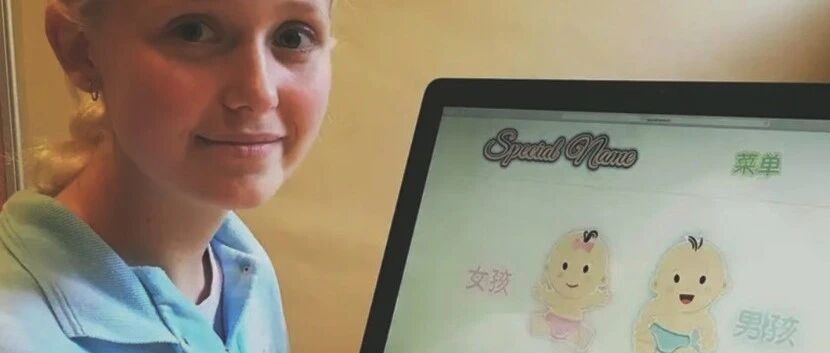
A British woman who once helped nearly one million Chinese families choose English names for their babies has died unexpectedly at the age of 27.
Beau Jessup, who first made headlines as a teenage entrepreneur after turning Chinese parents' demand for English baby names into a successful online business, was studying for a master's degree in journalism at Columbia University in New York. She was expected to graduate in May 2027.
Columbia Journalism School confirmed her death in a statement on Monday, November 9, expressing condolences to her family, friends and classmates. No details about when or where she died have been released. The New York City medical examiner is investigating the cause of death, which remains undetermined.
Jessup's story first attracted widespread attention in 2016, when she revealed that she had earned around £48,000 (approximately RMB 430,000 at the time) from her business at just 16.
But what connected a young British woman to nearly one million Chinese families? It all began with a Chinese mother who asked her to help choose an English name for her daughter.
A Chinese Mother's Request Sparked Her Business
Jessup's father had longstanding business connections with China, and she had visited the country several times and studied Mandarin.
During one visit, while having dinner with a Chinese friend of her father's, she was asked to suggest an English name for the woman's daughter. The mother hoped her child would grow up to be intelligent, independent and confident in expressing herself.
Jessup suggested Eliza, inspired by Eliza Doolittle, the heroine of the musical My Fair Lady. The mother was delighted with the choice.
What began as a simple favour soon gave Jessup a business idea. She realized that many other Chinese parents faced the same challenge: choosing an English name that sounded natural and carried a positive meaning.
After returning to the UK, she borrowed £1,500 from her father and launched SpecialName, a website designed to help Chinese parents select English names for their children.
The process was straightforward. Parents selected five personality traits they most hoped their child would develop from a list of 12. The website then recommended three names from a database of approximately 4,000 English names.
Each suggestion came with an explanation of its meaning, history and notable people who shared the name. The recommendations could also be shared directly on WeChat, allowing family members to discuss and make a decision together.
The service initially provided free suggestions to around 162,000 users before introducing a charge of approximately 60 pence per name.
By 2016, SpecialName had provided recommendations for more than 220,000 Chinese babies. The figure had risen to approximately 677,000 by 2019. Before her death, Jessup estimated that the platform had helped nearly one million babies choose English names.
Why Chinese Parents Turned to a British Teenager
The popularity of SpecialName reflected a growing demand among Chinese families for English names, particularly as international education, overseas travel and business connections became more common.
For many parents, an English name was seen as more than something their children could use in English classes. It could also be useful when studying abroad, working for international companies or communicating with foreign colleagues and business partners.
However, choosing an appropriate name was not always straightforward.
Names taken directly from films, video games or commercial brands could sometimes sound unusual or unintentionally amusing to native English speakers. Names such as Rolex, Gandalf and Cinderella were among the examples that British media had highlighted when discussing the issue.
Jessup's website sought to address this cultural gap by offering names that were not only meaningful but also familiar and appropriate in English-speaking environments.
In this sense, Chinese parents were not simply paying for an English name. They were also seeking advice on English-language naming conventions and cultural expectations from someone who had grown up in the UK.
Her Success Also Raised Questions About English Names
Jessup's business attracted considerable attention in China, with reports highlighting how a British teenager had turned the demand for English names into a profitable venture.
But her success also prompted a broader discussion: Why did Chinese children need English names in the first place, and was it necessary to have a native English speaker choose one?
Some viewed SpecialName as a practical service that helped Chinese families navigate unfamiliar language and cultural conventions.
Others questioned the assumption that Chinese people should change or adopt another name to fit into an English-speaking environment.
Some Chinese students studying overseas also shared experiences of foreign teachers who preferred to learn and pronounce their students' Chinese names correctly rather than ask them to adopt English ones.
The discussion even inspired a humorous suggestion online: if a British girl could build a business choosing English names for Chinese babies, why not create a website to help foreigners choose Chinese names?
Jessup's business thus reflected a particular aspect of China's growing international connections: the desire among many families to prepare their children for a world in which English plays an increasingly important role, alongside questions about cultural identity and the preservation of one's original name.
From Teenage Entrepreneur to Columbia Journalism Student
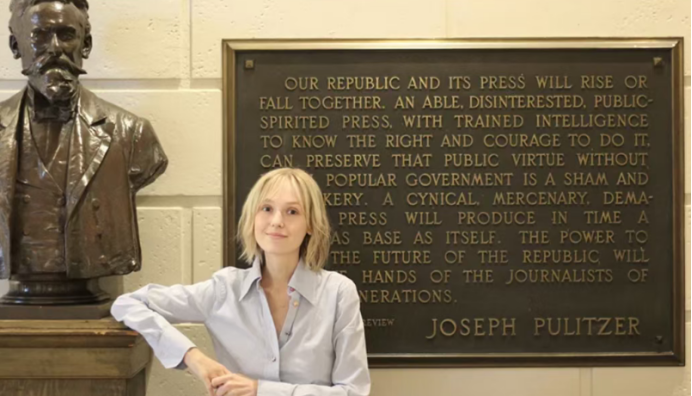
Jessup at Columbia University, beside a bust of Joseph Pulitzer.
Beyond her business, Jessup went on to build an impressive academic career.
She delivered a TEDx talk about her entrepreneurial experience and subsequently studied at the London School of Economics and the University of Cambridge before moving to the United States to pursue a master's degree at Columbia Journalism School.
She was featured in the school's Class of 2027 in September and had been expected to graduate in May 2027.
In an interview published by the school before her death, Jessup reflected on growing up with a famous mother and how that experience influenced her interest in journalism.
She said she had become aware from a young age of the gap between people's actual lives and the stories told about them, as well as how those stories could be simplified or distorted in the public eye.
She described journalism as a way to illuminate people's experiences and said she was drawn to the profession for its power and immediacy.
Columbia later published the full interview — conducted in October as part of its student Notebook series — on November 11, with her family's permission.
Her mother, British actress and television presenter Lisa Maxwell, also shared a photograph of Jessup with her classmates on social media in September, congratulating her daughter and expressing pride in her achievements.
Jessup's life ended at just 27, before she could complete the journalism degree she had been working towards.
For many Chinese families, however, her name will remain connected to something much more personal: the English names she helped them choose for their children.
A chance request from a Chinese mother had sparked an unexpected business, connecting a young woman from the UK with hundreds of thousands of families in China. What began with a single name eventually became a story remembered by nearly one million families.
Sources: Columbia Journalism School; USA Today; Daily Mail
No comments:
Post a Comment