
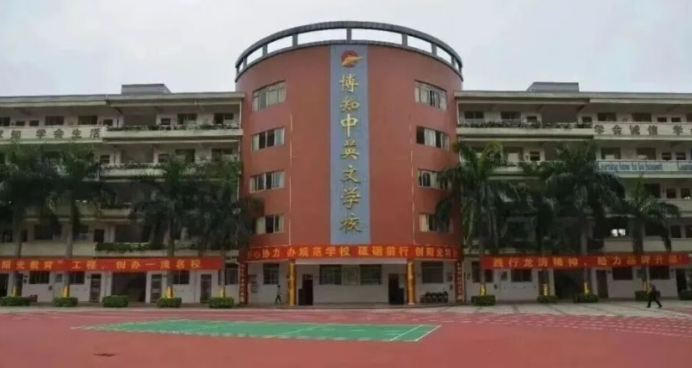
Guangzhou Huadu Bozhi Chinese-English School has officially completed its deregistration, seven months after receiving approval to terminate its operations — bringing nearly two decades of schooling to an end.
The Huadu District Civil Affairs Bureau issued the deregistration approval, following an earlier decision by the district's education authority on March 25, 2026, approving the school's application to cease operations.
Founded in December 2006, the school had been operating for almost 20 years. Although neither approval document specified the reasons for its closure, the case highlights the growing challenges facing some private schools amid declining student numbers, expanding public-school capacity, and intensifying competition in Guangzhou's education market.
Source: OT-Team (G), Study Abroad Magazine
Two Approvals, Seven Months Apart: What Happened?
The first approval came from the Huadu District Education Bureau on March 25, 2026. It was issued under Articles 56 to 60 of the Law on the Promotion of Privately-run Schools, which cover the circumstances under which private schools may terminate operations, liquidation procedures, the order in which assets must be used to settle obligations, and the subsequent withdrawal of school licenses, destruction of official seals, and deregistration.
One detail in the approval is particularly noteworthy. The education bureau stated that it had received the school's application materials concerning the termination of its operations. This indicates that the closure was initiated by the school itself, rather than resulting from the revocation of its school license or an administrative order requiring it to shut down.
The second approval came from the Huadu District Civil Affairs Bureau, which oversees the school's legal entity registration. As a private non-enterprise entity, the school was subject to two separate administrative procedures: the education authority handled its school operating qualifications, while the civil affairs authority was responsible for its legal registration.
The deregistration approval required the school to settle its bank accounts and surrender both the original and duplicate copies of its registration certificate, along with its official seals.
Under the Regulations on the Implementation of the Law on the Promotion of Privately-run Schools, a private school voluntarily terminating its operations must publish an announcement of its proposed closure at least six months in advance, formulate a termination plan in accordance with the law, organize liquidation, and then apply to the registration authority for deregistration. The seven-month interval between the two approvals is broadly consistent with the time needed to complete these procedures.
The law also requires private schools to make proper arrangements for enrolled students before terminating operations. For private schools providing compulsory education, the education authority must assist in arranging for students to continue their education elsewhere.
The law further specifies the order in which a school's assets must be used to settle its obligations: first, refunds of tuition and miscellaneous fees; second, outstanding staff salaries and social insurance contributions; and finally, other debts.
The completion of the deregistration process indicates that the school has gone through the required formal procedures for termination and liquidation.
Why Did the School Close?
Despite having "Chinese-English" in its name, Guangzhou Huadu Bozhi Chinese-English School was not the type of international school that many people might associate with bilingual education.
Public registration records identify it as a private non-enterprise entity, with registered capital of RMB 100,000 and Chen Yuetong listed as its legal representative. Its registered scope of activities covered nine years of compulsory education, from primary through junior secondary school.
The school was established by Guangdong Longtao Education Group in late 2006. According to an industry commentator who has long followed school selection trends in South China, Bozhi followed a budget-friendly bilingual education model, with annual tuition below RMB 10,000. Its main target market consisted of migrant-worker families and other households with limited education budgets that needed a school close to home.
This positioning gave it some advantages over public schools, including a bilingual offering and greater flexibility in certain aspects of its curriculum. However, it lacked the comprehensive curricula and established university placement records of leading international schools, while also lacking the pricing and institutional advantages of public schools.
In other words, its competitiveness depended on occupying a middle ground: offering somewhat more than a conventional public school at a fraction of the cost of an international school. That model could work when student numbers were sufficient. But when the pool of potential students shrinks, schools occupying this middle ground can be among the first to feel the pressure.
There are also signs that the school had faced administrative compliance issues in previous years. According to Tianyancha, a Chinese business information platform, it was placed on the List of Social Organizations with Abnormal Operations twice, on October 22, 2020, and October 28, 2023. Both listings were attributed to its failure to submit annual work reports within the prescribed deadlines.
Although the official closure approvals did not disclose a specific reason for the school's termination, several broader pressures affecting its market position are worth examining.
1. Fewer Children, a Shrinking Student Pool
According to publicly available figures cited in media reports, China's annual birth count fell from 18.83 million in 2016 to below 10 million in 2022, reaching approximately 7.92 million in 2025. That represents a decline of more than half in less than a decade, significantly reducing the number of children entering the education system.
For private schools that depend on tuition-paying students, the shrinking population creates an increasingly challenging recruitment environment.
2. Public Schools Are Expanding
At the same time, public-school capacity in Guangzhou continues to grow. According to the 2026 senior high school enrollment plan released by the Guangzhou Education Bureau in May, the city planned to admit 101,720 students to regular senior high schools, an increase of 11,244 from the previous year. The total number of planned admissions has increased by more than 10,000 for three consecutive years.
Of the 2026 total, public schools, including publicly funded classes in private schools, accounted for 79,211 places, an increase of 9,025, or 12.86%, year on year.
As public-school capacity expands and educational quality improves, more families may naturally favor public institutions. For tuition-charging private schools, this means facing competition from an increasingly accessible alternative.
3. A Bilingual Label Is No Longer Enough
Enrollment figures also suggest growing differentiation within the private education sector. According to data from the Guangzhou Admissions and Examination Service Center, the overall fulfillment rate for 2026 enrollment plans at private senior high schools (excluding publicly funded classes) and Chinese-foreign cooperative education programs was 71.19%.
Private senior high schools recorded a fulfillment rate of 72.99%, an improvement over 2025. However, after the regular admissions process ended, private senior high schools still had 5,892 unfilled places, while Chinese-foreign cooperative education programs had another 892 places left vacant.
The improved fulfillment rate suggests that leading private schools are recovering some of their appeal. Yet nearly 30% of the planned places across the two categories remained unfilled. This points to continued enrollment pressure among schools outside the top tier. Rather than improving across the board, the private education market appears to be becoming increasingly divided between stronger and weaker institutions.
The Bigger Picture: Some Schools Are Closing, Others Are Expanding
It would be easy to interpret Bozhi's closure as evidence that private education in Guangzhou is generally contracting. However, developments in 2026 suggest a more complicated picture.
During the same year, several internationally oriented schools with established brands and distinctive curricula opened new campuses in Guangzhou. Some schools are exiting the market while others are entering or expanding. The two trends occurring simultaneously suggest that demand for private education has not simply disappeared. Instead, the criteria by which parents choose schools are changing.
Families are increasingly looking for distinctive educational offerings rather than paying simply for a school to carry the label of a private institution.
Proposals discussed during Guangzhou's 2026 Two Sessions also point in this direction. They called on private senior high schools to shift their focus from expanding enrollment to improving educational quality, with greater emphasis on distinctive programs in science and technology, arts, sports, and international curricula.
Ultimately, Bozhi's challenge may not have been that it was a private school, but that its level of differentiation was insufficient to sustain its position in an increasingly competitive market with a shrinking pool of students.
As Guangzhou's education sector continues to evolve, schools that cannot offer a compelling reason for families to choose them may find it increasingly difficult to survive.
No comments:
Post a Comment