
A 76-year-old Singaporean tourist who nearly lost his life after falling critically ill on a trip to Xinjiang has made an extraordinary decision: he will donate 100,000 yuan (about S$19,150) to the hospital that saved him — every year.

Koh Sim Hock (许森福) was travelling from Tashkurgan Tajik Autonomous County towards Shache County in the Kashgar area of Xinjiang when he suddenly developed severe breathing difficulties on October 14, 2026. His family rushed him to Shache County People's Hospital, where doctors found he was suffering from left heart failure with acute pulmonary oedema, Type I respiratory failure and cardiogenic shock. He was admitted to the intensive care unit immediately.
A Holiday That Turned Into a Fight for Breath
According to the Xinjiang government's official account, Koh's emergency was triggered by acute high-altitude pulmonary oedema. His blood oxygen levels fell sharply, and his condition was complicated by underlying health problems, including severe hypertension, type 2 diabetes and impaired liver function.
Recalling the ambulance journey, Koh said he had become so breathless that he could barely breathe at all. His wife described watching his oxygen readings fall from around 50 to 38, and said she was terrified.
What had started as a holiday in China's far northwest had suddenly become a medical emergency.
The Intensive Care Team's Race Against Time
The hospital's intensive care specialists moved quickly to stabilise Koh's breathing and heart. Leading the effort was Zou Hai, an emergency and critical care specialist from Shanghai's Pudong New Area People's Hospital, who was in Xinjiang as part of Shanghai's 12th group of medical aid workers supporting the region. He worked alongside the local medical team, and together they brought Koh back from the brink.
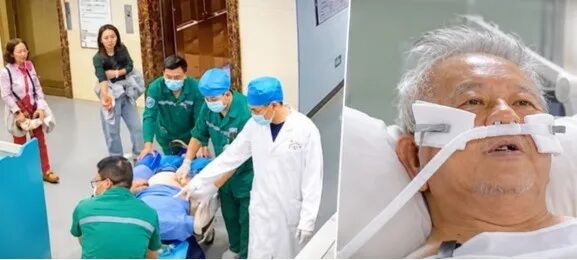
On October 17, three days after he fell ill, Koh was taken off ventilator support — a major turning point after days in critical condition. But his recovery was not yet complete: he continued to suffer from watery diarrhoea, abdominal bloating and severe thirst.
The hospital then consulted Hu Xinmin, a traditional Chinese medicine specialist from Fudan University-affiliated Pudong Hospital in Shanghai, who was also assisting medical teams in the area. A personalised herbal treatment plan was drawn up for Koh, and after six days his digestive symptoms had improved significantly and his thirst had eased.
It is worth being clear about what happened here: the intensive care team first saved Koh's life with emergency treatment. The herbal treatment that followed addressed the digestive problems that lingered after his vital signs had stabilised — it was part of his recovery, not the rescue itself.
From Patient to Donor
After recovering and being discharged, Koh began thinking about how to thank the people who had saved him. Rather than simply thanking the doctors and nurses, he and his family decided to help other patients who struggle to pay for treatment.
On October 29, Koh signed a donation agreement with Shache County People's Hospital, pledging 100,000 yuan a year as a designated donation to help financially disadvantaged inpatients, particularly those in the intensive care department. The hospital said it was the first time it had ever received an individual targeted donation of this kind.
"This experience moved me deeply," Koh said. "I want to do what I can, within my means."
Hospital president Chen Xingyi said the donation showed that patients recognised the hospital's medical care and service, and promised the hospital would manage every yuan carefully so it reaches patients who genuinely need help.
A Reminder for Travellers
Koh's story is also a warning for anyone travelling to high places. Xinjiang covers a vast area, including mountainous regions at considerable altitude, and moving between elevations can be risky — especially for older travellers and people with existing health conditions.
Serious breathing difficulty while travelling needs emergency attention immediately. Before visiting high-altitude destinations, older travellers and anyone with a heart or lung condition should talk to a doctor about whether the trip is suitable and what precautions to take. Travel insurance with proper medical cover matters too, particularly in remote areas where a medical transfer can be complicated.
One medical emergency changed the course of Koh's holiday. His decision to donate 100,000 yuan every year could change the lives of many patients who have yet to walk through the hospital's doors.
No comments:
Post a Comment